Contents
Introduction
When working with data, you’ll often hear three terms:
- Database
- Data Warehouse
- Data Lake
At first, they can seem similar – but they serve very different purposes in modern data systems.
Understanding these differences is essential if you’re working in data engineering, analytics, or AI systems.
What is a Database?
A database is used to store and manage real-time transactional data.
As explained in the source , databases typically use OLTP (Online Transaction Processing) systems.
Key Characteristics:
- Stores structured data (tables with rows & columns)
- Handles real-time transactions
- Highly detailed data
- Flexible schema
Example Use Cases:
- E-commerce orders
- Banking transactions
- User accounts
Databases are optimized for writing and updating data quickly
What is a Data Warehouse?
A data warehouse is designed for analytics and reporting.
Unlike databases, it uses OLAP (Online Analytical Processing).
How Data Gets In:
Data is moved using an ETL process:
- Extract data from sources
- Transform it (clean, aggregate)
- Load into warehouse
Key Characteristics:
- Stores historical data
- Data is often summarized
- Optimized for fast queries
- Rigid schema (needs planning)
Example Use Cases:
- Business intelligence dashboards
- Sales reports
- Data analytics
Data warehouses are optimized for reading large datasets efficiently
What is a Data Lake?
A data lake is designed to store raw, unstructured, and massive amounts of data.
Key Characteristics:
- Stores structured + unstructured data
- Data is kept in raw format
- Highly scalable
- Flexible schema (schema-on-read)
Example Use Cases:
- Machine learning datasets
- Images, videos, logs
- Big data storage
Data lakes are ideal for AI, ML, and experimentation
Database vs Data Warehouse vs Data Lake
| Feature | Database | Data Warehouse | Data Lake |
|---|---|---|---|
| Purpose | Transactions | Analytics | Storage (raw data) |
| Data Type | Structured | Structured (processed) | All types |
| Processing | OLTP | OLAP | Mixed |
| Data Freshness | Real-time | Batch (ETL dependent) | Raw ingestion |
| Schema | Flexible | Rigid | Flexible |
| Performance | Fast writes | Fast reads | Scalable storage |
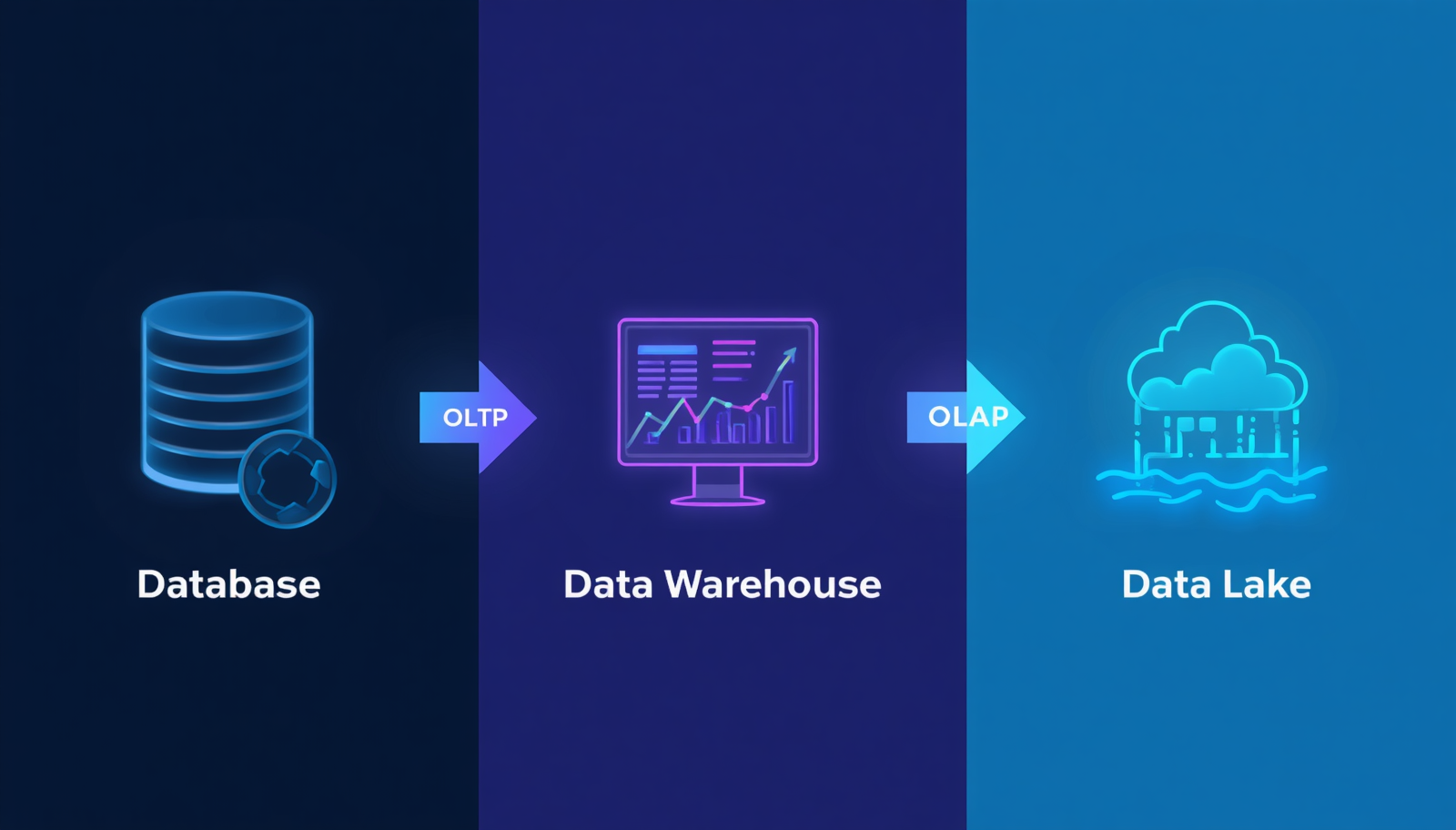
How They Work Together
Modern systems often use all three together:
- Database → Stores real-time data
- Data Warehouse → Analyzes processed data
- Data Lake → Stores raw & large-scale data
This creates a complete data ecosystem
Key Differences (Simple Explanation)
- Database → “What’s happening right now?”
- Data Warehouse → “What happened over time?”
- Data Lake → “Store everything (we’ll figure it out later)”
When to Use Each
Use Database:
- Real-time applications
- Transaction systems
Use Data Warehouse:
- Reporting & analytics
- Business intelligence
Use Data Lake:
- Big data storage
- Machine learning
- Unstructured data
Real-World Insight
No single solution fits all use cases.
As highlighted in the source :
Companies often use all three together depending on their needs.
Final Thoughts
Understanding these three systems is crucial for:
- Data Engineers
- Backend Developers
- AI Engineers
Modern architectures combine them to build scalable, intelligent data systems